SaaS-sector consultancy website design: the brief
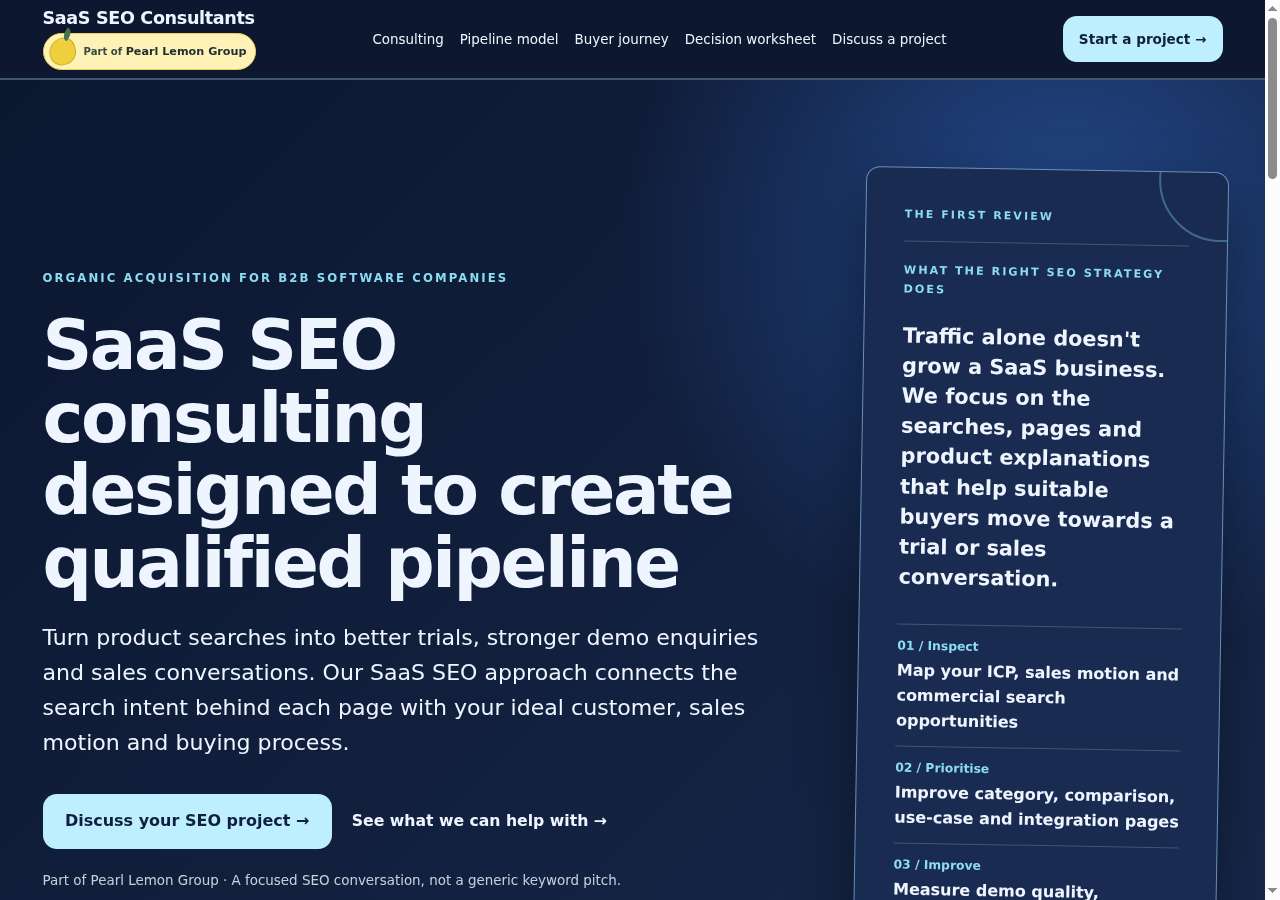
SaaS SEO Consultants is a Pearl Lemon-owned professional-services website for B2B software teams. It is not a SaaS application or a claimed commissioned software-product design project. That distinction is central to the case study: the website must explain why software businesses need different SEO and buying journeys without inventing product screens or integrations.
We can inspect three concrete choices: separate buying-journey content, a browser-based pipeline worksheet and a scoped consultation route. Those pages demonstrate information architecture and a useful decision aid; they do not prove more product demos, higher rankings or additional revenue.
First make the business model unmistakable
A software company, a SaaS marketing consultancy and a product comparison portal can use similar vocabulary but have very different conversion journeys. The live SaaS SEO Consultants website is explicit that it consults for B2B SaaS teams. It is not itself a product with free trials, login screens or an integration marketplace.
The homepage opens with a commercial question: how can organic discovery become relevant trials, demonstrations and sales conversations? The design draws a boundary between receiving more traffic and improving qualified pipeline. That distinction informs its headings, examples and enquiry prompts.
For a company selling software, the useful lesson is not to copy the consultancy’s navigation. It is to decide whether a visitor needs product proof, a use-case explanation, integration detail, procurement reassurance or an actual conversation before building the page.
Three SaaS sales motions, three different content needs
The live site distinguishes enterprise buyers, product-led users and sales-led teams. An enterprise visitor might need implementation, procurement and security detail. A product-led visitor may need a concrete use-case or integration answer. A sales-led visitor needs evidence that the product is suitable for their account and problem.
Its SaaS buying journey and consulting service therefore sit alongside an SEO pipeline model rather than being merged into one enormous services page. Navigation explains the different questions, not simply a list of interchangeable keywords.
That is a transferable information-architecture decision. A SaaS product website could express the same principle through product tours, integration pages, pricing explanations and relevant comparison content, using evidence supplied by the actual product team.
The most useful page is a worksheet, not another promise
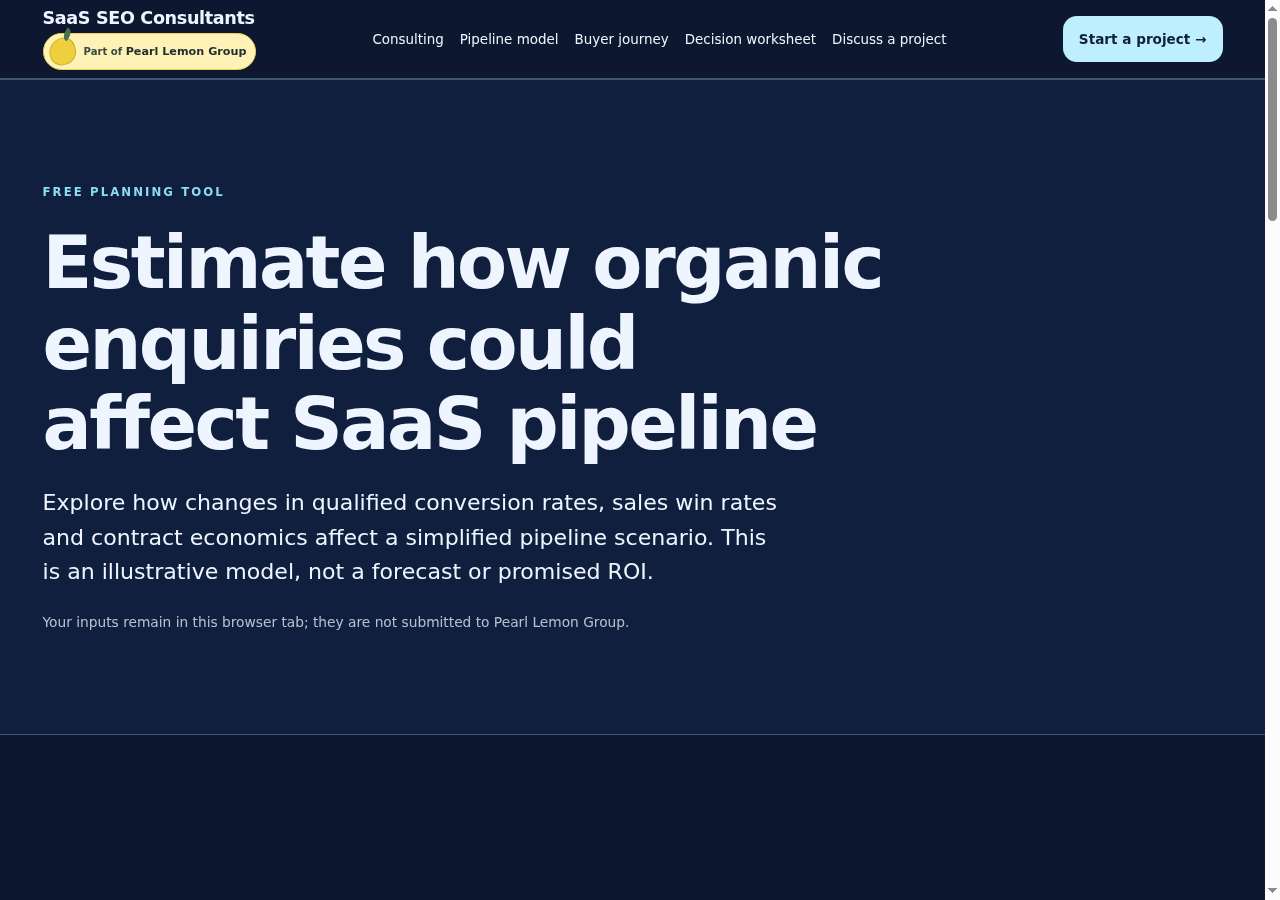
The free pipeline worksheet asks visitors to examine six assumptions connecting organic visits to qualified opportunities. It then models a hypothetical enquiry cohort using user-entered qualification, win-rate and account-economics assumptions.
The interface explicitly identifies the numbers as illustrative. Fractional expected wins are mathematical averages, not actual customers; churn, sales lag and other costs are omitted. The worksheet is valuable because it makes a hidden commercial assumption visible. Visitors can challenge the model before purchasing services.
This small interaction also avoids a common design trap: requiring an email address to access every helpful resource. The worksheet says selections stay within the browser tab.
From content to a properly scoped conversation
The consultation route asks what the business sells and which enquiries matter. A service buyer is invited to discuss scope, rather than assume that all SaaS companies need the same package. The site identifies its Pearl Lemon Group ownership and avoids guaranteed search rankings or unverifiable results.
Technical restraint is part of the design: meaningful pages and links are available as crawlable content, with the browser worksheet adding value where interaction genuinely helps. We do not claim that this site has achieved any particular organic ranking or contributed a measured volume of pipeline.
B2B SaaS website design: separate the jobs of each page
| Page intention | The consultancy example | How a SaaS product site might adapt it |
|---|---|---|
| Explain category relevance | Sector-specific SEO and buying-journey content | Clear use-case and category pages showing the actual product fit |
| Reduce procurement uncertainty | A candid description of consultancy scope | Verified security, implementation and data-handling details |
| Make value tangible | An adjustable organic pipeline worksheet | A calculator grounded in actual product economics, with assumptions visible |
| Move to the right next step | A scoped consulting conversation | Trial, demo or sales conversation suited to the sales motion |
Is this evidence of a SaaS product design project?
No. SaaS SEO Consultants sells a professional service to SaaS businesses. The site is useful as an example of B2B software-sector language and information architecture, but it cannot demonstrate product onboarding, billing, authentication, real integration workflows or an actual SaaS interface.
When should a SaaS business use a calculator?
When a calculation clarifies a genuine purchasing assumption and the user can inspect inputs. A worksheet that silently assumes perfect qualification or instant revenue would weaken trust. The published example makes its hypothetical nature explicit.
What a software business can take away
- Distinguish a SaaS product, its buyer and the service providers around it. A case study should never blur these.
- Organise content around buying motions and questions instead of repeating a generic SaaS landing page.
- Let a working tool clarify the economic decision; label assumptions and limitations clearly.
- Ask for enough business context to qualify the next conversation without presenting a form as proof of conversion.
For the actual £5,000 commercial offer, see SaaS website design. A product website with interactive demonstrations, authentication or deep integrations would need a separately agreed scope.
Verified 30 October 2026: public homepage, service routes and browser-based pipeline worksheet inspected. No product-company commission, results or performance uplift is asserted.