Property data portal website design: the project
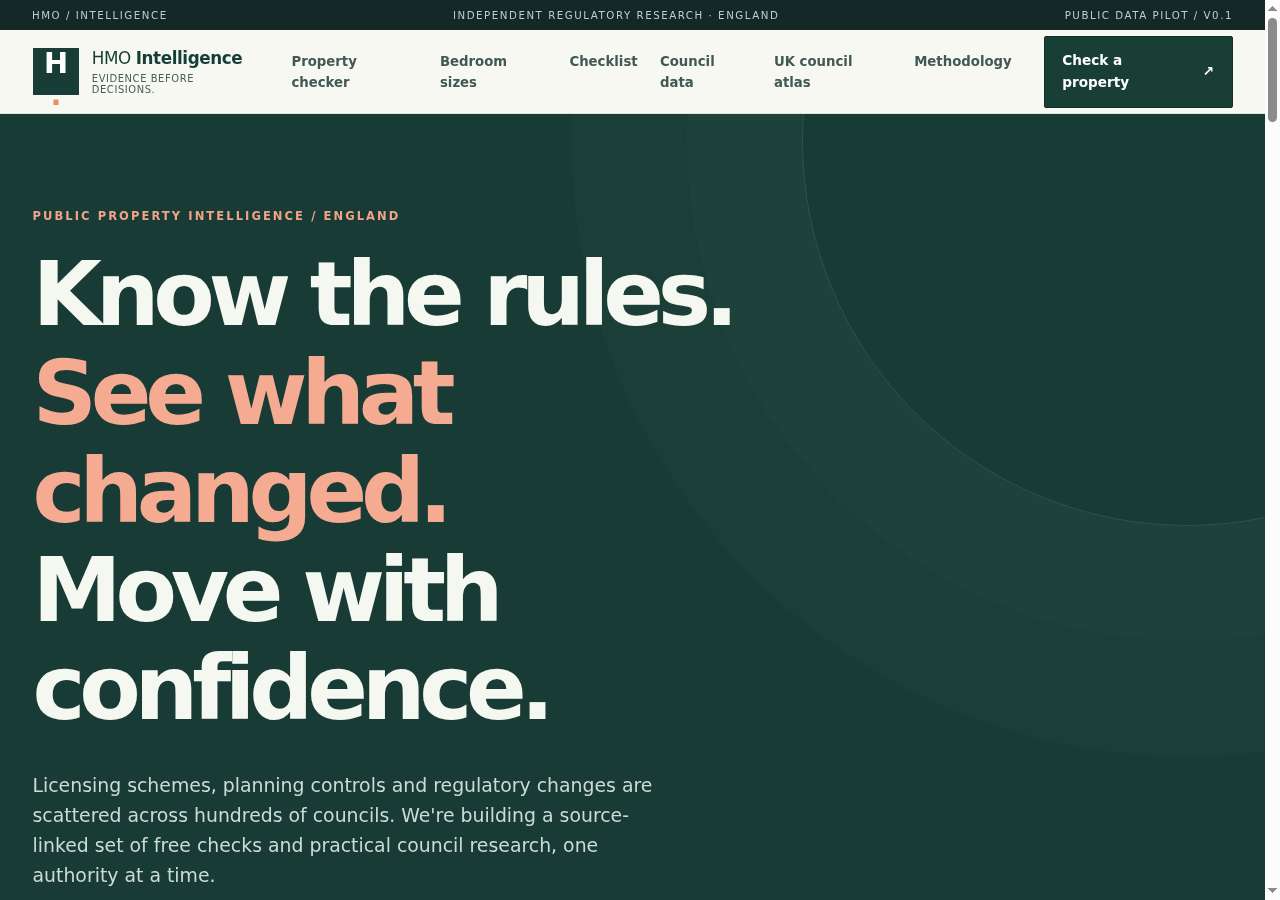
HMO Intelligence is a public property-research platform created within the Pearl Lemon portfolio. Its design challenge is unusually specific: turn scattered local-authority licensing and planning evidence into something navigable without suggesting that incomplete data means a property is compliant.
The live evidence includes a searchable UK authority atlas, an England-focused HMO screening tool and a methodology page that explains where source research begins and verified decisions end. This is an example of data-portal information architecture and cautious interface design—not a statutory licensing service, complete UK regulatory database or a proven revenue result.
Why information architecture matters more than a beautiful chart
House in Multiple Occupation rules sit at the intersection of licensing, planning and property management. A single national-looking answer can be dangerously misleading when the real decision depends on the local authority, the property, occupancy, applicable dates and sometimes an Article 4 direction.
The live HMO Intelligence website starts with that complexity. It explains the difference between source discovery, researched local guidance and independently verified statutory decisions. That is an unusually important design choice: a missing record must never be presented as proof that no rules apply.
Instead of promising a complete answer, the page lets people identify their council and follow a credible research trail. The site is a public information product, not a full-service property management homepage or a sales catalogue.
An atlas is useful only if its coverage is legible
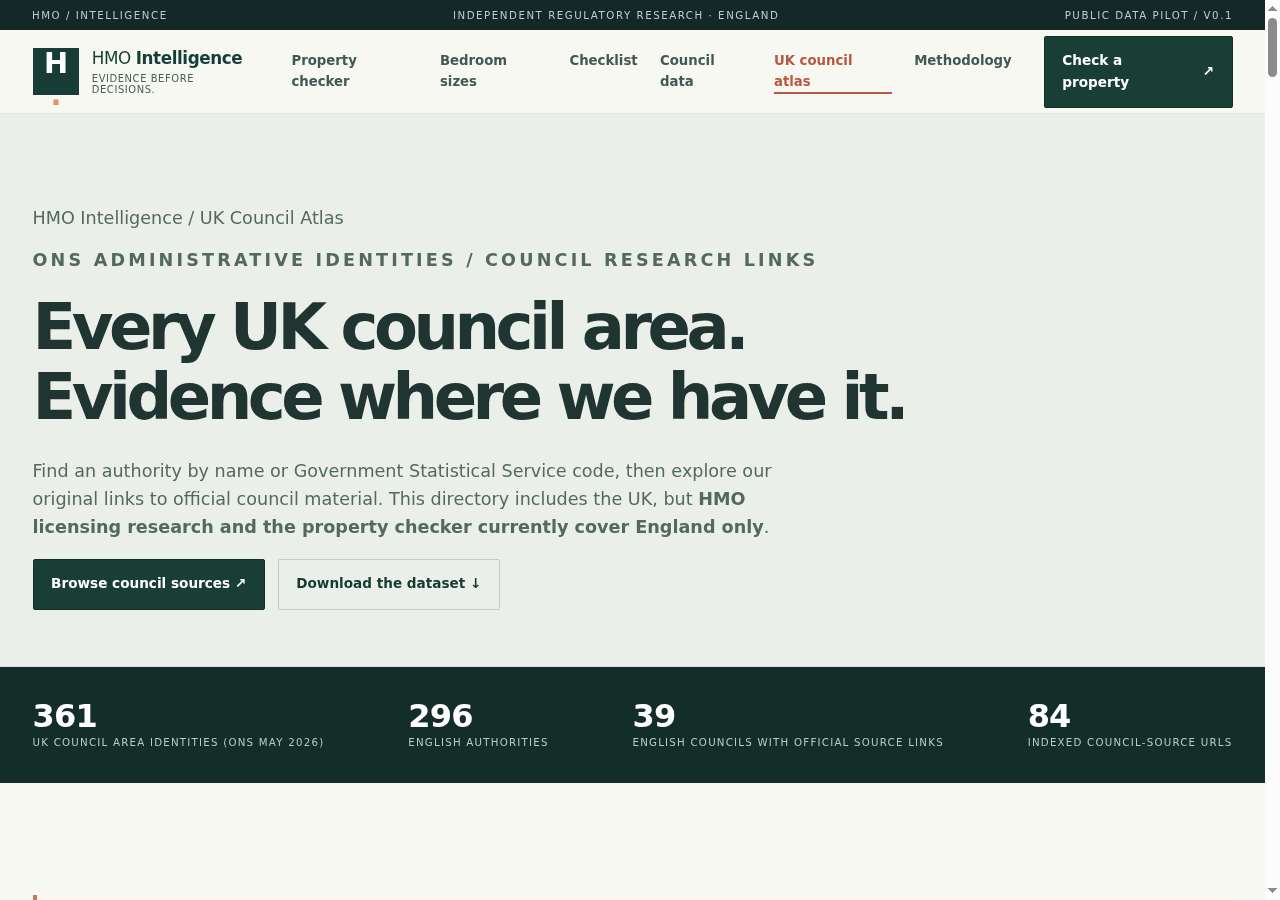
The UK council atlas uses official authority names and statistical codes to organise local administrative identities. Each entry distinguishes authorities with linked research from those not yet researched. The atlas spans UK authority identities, while the HMO licensing research and checker are currently England-focused.
That split is both a technical and editorial design decision. A large directory can create a false impression of comprehensiveness. Here, coverage labels do the opposite: they tell readers what is available, where the original sources are and which gaps remain.
The council research directory allows a reader to move from a general question to a specific local evidence page. Dates, fees and designation status should always be checked against the linked official notice before action.
Tools designed around bounded questions
The HMO screening tool begins with property and occupancy context. The room-size calculator addresses a narrower national floor-area question, and the compliance checklist helps users work through documents and obligations.
These are different tasks. Combining them into a single apparently definitive “property approved” score would hide uncertainty. A better experience separates research, arithmetic and a next-step checklist and explains what each can—and cannot—establish.
This is also why a dashboard-like interface is not enough to describe the project. The defensible value is the underlying structure: source attribution, coverage status, specific questions, dated changes and pathways to further verification.
Evidence before scale
The homepage links to public methodology and data coverage information. Its editorial model distinguishes indexed official source links from independently approved regulatory determinations; counts and local rules can change.
No automated system should turn a scraped council announcement into a legal guarantee. This site visibly cautions users to check current council notices and the exact property. We are not claiming that the platform replaces a lawyer, licensing officer or property manager, or that its research has increased conversions or generated revenue.
Data dashboard website design: three kinds of uncertainty
| Data problem | Interface response | Why it matters |
|---|---|---|
| The council exists but no research is available | The atlas marks that authority as not yet researched | Missing data must not be confused with a clean bill of compliance. |
| A public source exists but needs interpretation | Source-linked council research explains the evidence trail | Readers can locate the originating notice and check effective dates. |
| A user needs an initial answer for a property | The checker and separate room-size tool pose bounded questions | A screening aid cannot grant permission, determine lawful use or replace professional review. |
What separates a data website from a collection of SEO location pages?
A meaningful data portal has a defensible entity model, navigable relationships, source links, coverage indicators and explicit missing-data behaviour. A page for each council is only valuable where the underlying evidence and status justify it. This project visibly distinguishes a UK-wide administrative directory from England-focused HMO licensing research.
Should this be sold as a £5,000 dashboard build?
Not by default. The Five Grand Websites offer covers a separately scoped standard marketing website. A live regulatory data portal with ingestion, maintenance, application logic and legal review has a different operating cost and risk profile.
Lessons for any complex data or professional-service site
- Show where a record came from, when it was reviewed and what remains unknown.
- Make searchable directories useful through meaningful coverage status, not inflated totals.
- Give each calculator one defensible question; avoid a false all-purpose score.
- Connect the research experience to the appropriate human service without pretending data access is a completed professional assessment.
For a commercial services interpretation, see property management website design. This live project is a research platform with interactive tools, not a promise that such functionality is included in the standard £5,000 marketing-site package.
Verified 30 October 2026: homepage, searchable council atlas and publicly linked tools inspected. No statutory approval, complete coverage or commercial outcome is claimed.