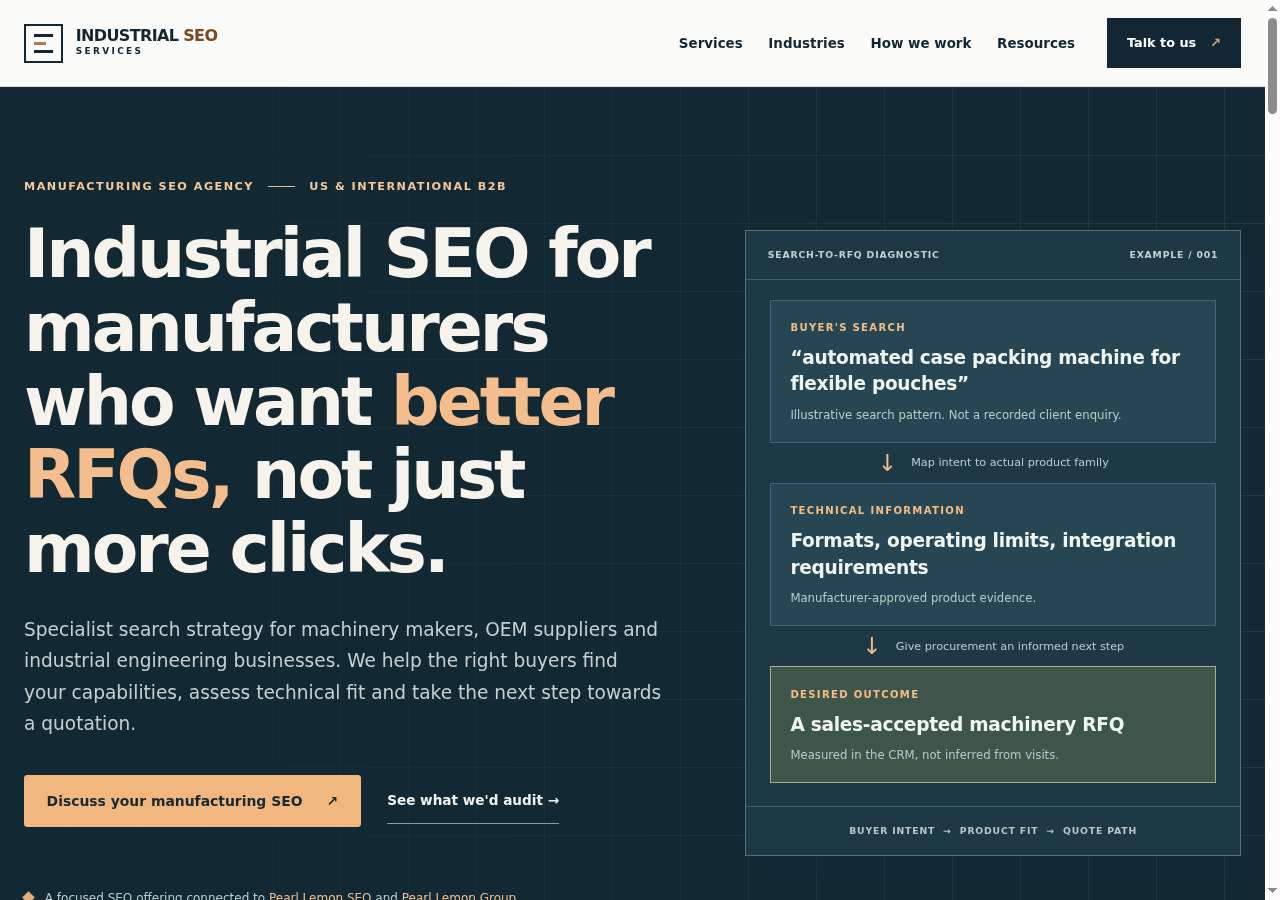
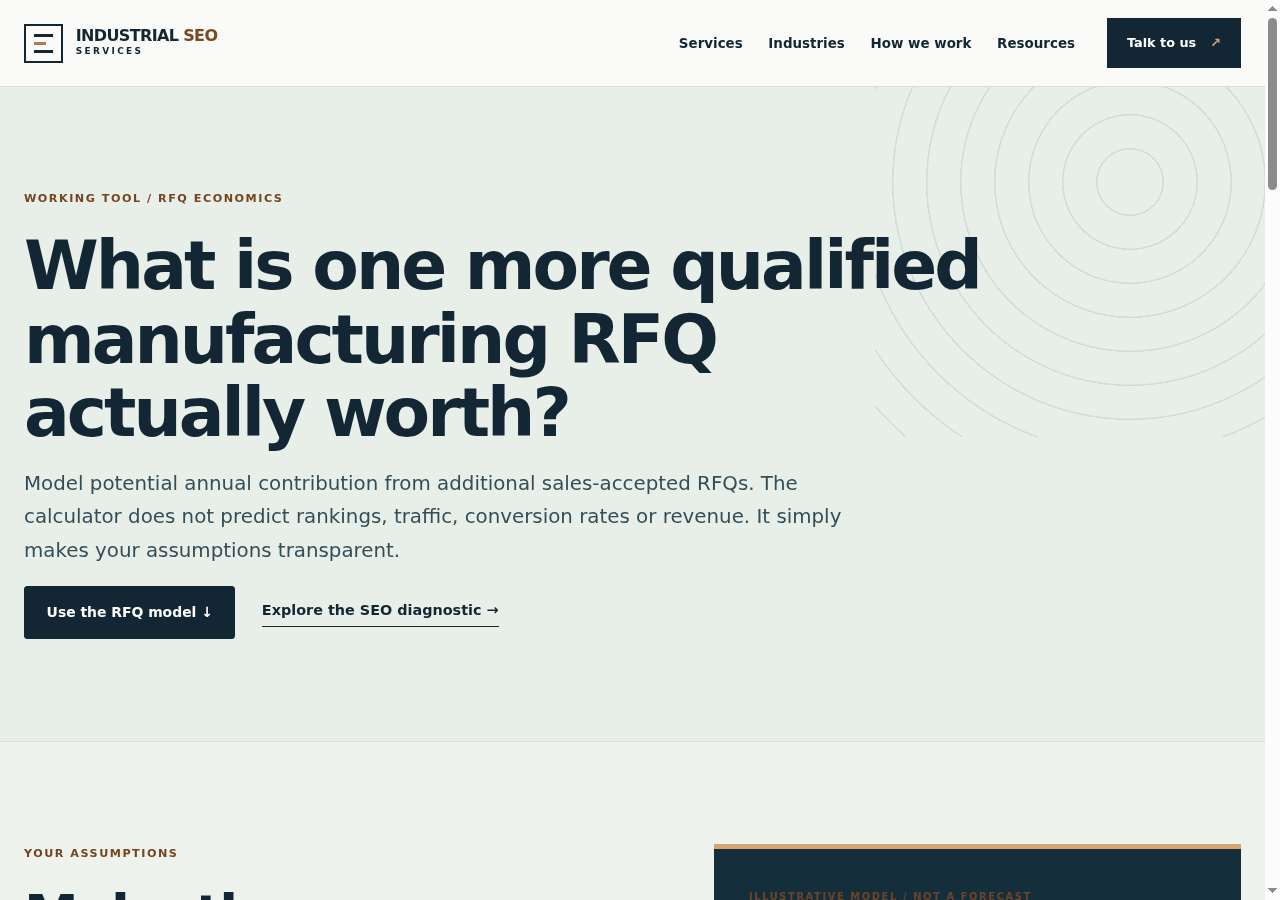
Industrial website design: the build at a glance
Industrial SEO Services is a real website built for a Pearl Lemon-owned specialist SEO offering—not a manufacturer’s catalogue and not an outside factory commission. The design problem was to explain technical B2B search to people who care about specifications, supplier suitability and valuable requests for quotation (RFQs).
We organised the site around manufacturing sectors and buying questions, then added a working RFQ economics model and a scoped enquiry route. Open the three live examples above to inspect the work. They demonstrate the website’s structure and interaction, not unverified ranking growth, signed manufacturing orders or a particular client ROI.
The challenge: engineers do not buy from agency adjectives
An industrial audience does not arrive looking for a mood board. A procurement or technical decision-maker is likely weighing equipment families, applications, manufacturing processes, supplier fit and the cost of a poor enquiry. Industrial SEO Services needed to show the work behind its specialist positioning rather than imitate a manufacturer’s product catalogue.
The published homepage therefore leads with a distinction: better RFQs, not simply more clicks. It explains that the offering is SEO expertise from Pearl Lemon for machinery makers, OEM suppliers, precision engineers and industrial automation firms. That boundary matters: a useful technical website needs to speak the buyer’s language without claiming engineering qualifications it does not possess.
The architecture we built: specific routes instead of generic services
The site separates industrial buyer types into dedicated pages for machinery manufacturers, OEM suppliers and precision engineering. Each route can address a different decision: machine families and applications, repeatable supplier capabilities, or material and batch-volume fit.
Service pages then cover manufacturing SEO, catalogue and product SEO, RFQ conversion and international industrial SEO. This is deliberately more useful than creating interchangeable pages for every slight keyword variation. The navigation helps visitors recognise the problem that brought them there.
The page structure also distinguishes the SEO service from the manufacturer’s responsibilities. A real client must confirm technical tolerances, quality systems and capacity; the website does not invent those facts to look authoritative.
A small tool that makes the commercial problem tangible
One distinctive part of the build is the manufacturing RFQ economics model. A visitor can enter additional sales-qualified RFQs per month, expected win rate, contribution per won deal and programme spend. The calculator shows the arithmetic behind a scenario; it does not forecast search traffic, rankings or orders.
This was a useful interface decision. It puts the conversation in terms of contribution and sales acceptance rather than raw contact forms. It also makes the caveat visible: if a business cannot fulfil an enquiry or does not know its historic closing rate, a larger traffic number is not a business case.
The technical hand-off matters as much as the design
The site was developed in Astro and deployed through Cloudflare Pages with a GitHub-managed source. The manufacturing enquiry page asks for the company, manufacturing challenge and optional product and target-market context. The production build uses a Cloudflare-backed enquiry endpoint, D1 storage and Turnstile verification. The separate notification path and lead qualification still require operational checks; submitting a form is not equivalent to winning a lead.
The October 2026 project work also included resource pages, an audit guide, the methodology, structured search pages and launch checks. In technical SEO, the important design decision was to keep meaningful HTML content and working navigation available without asking the visitor to wait for a giant client-side interface to initialise.
What is live, and what remains unproven?
You can inspect the homepage, run the RFQ model and open the contact journey. Those are real, public outputs.
We are not presenting a manufacturer success story, a traffic uplift, conversion improvement, or closed deals. Those claims would need independent measurements and appropriate evidence. The case study demonstrates information architecture, technical implementation and useful interaction—not a fabricated commercial result.
Industrial website architecture: what a technical buyer can verify
| Buyer question | What the published site provides | Why the design choice matters |
|---|---|---|
| Do you understand our type of manufacturing? | Separate machinery, OEM and precision-engineering pathways | Sector language can be specific without inventing client engineering credentials. |
| What counts as a valuable enquiry? | An RFQ economics model using user-supplied win-rate and contribution assumptions | It shifts the discussion away from undifferentiated traffic forecasts. |
| What should I send first? | A contact route centred on the company’s challenge and target market | A first brief can be useful without requesting confidential drawings. |
| Can search engines read the core content? | Public, descriptive HTML pages and conventional links | Discoverable content does not depend on a decorative interactive dashboard. |
What would a manufacturer’s own website need beyond this example?
An actual manufacturer would need confirmed machine capabilities, tolerances, materials, accreditations, manufacturing locations, lead times and authorised project photography. None should be generated from a design template. The transferable part of this case study is the buyer-first information architecture, not fictitious technical specifications.
A manufacturing buyer looking for plant capacities should not land on this specialist SEO service and mistake it for the factory itself. That separation is essential to accurate industrial website design.
Three lessons another technical B2B site can use
- Lead with the specification or buying problem, not a broad promise to transform the industry.
- Structure services and sectors around distinct buyer decisions, not nearly identical SEO phrases.
- Define the valuable enquiry before designing the form and the reporting dashboard.
For the corresponding commercial offering, see our manufacturing website design approach. The example above shows how a specialist service site handles complexity; a genuine manufacturer’s own website would require its actual machinery, certifications, capacities and approved technical evidence.
Verified 30 October 2026: live homepage, RFQ model and contact page inspected. Source-backed build details are from the Pearl Lemon EMD Factory repository. This page does not claim rankings, sales outcomes or external client endorsement.