Consultant and personal brand website design: the brief
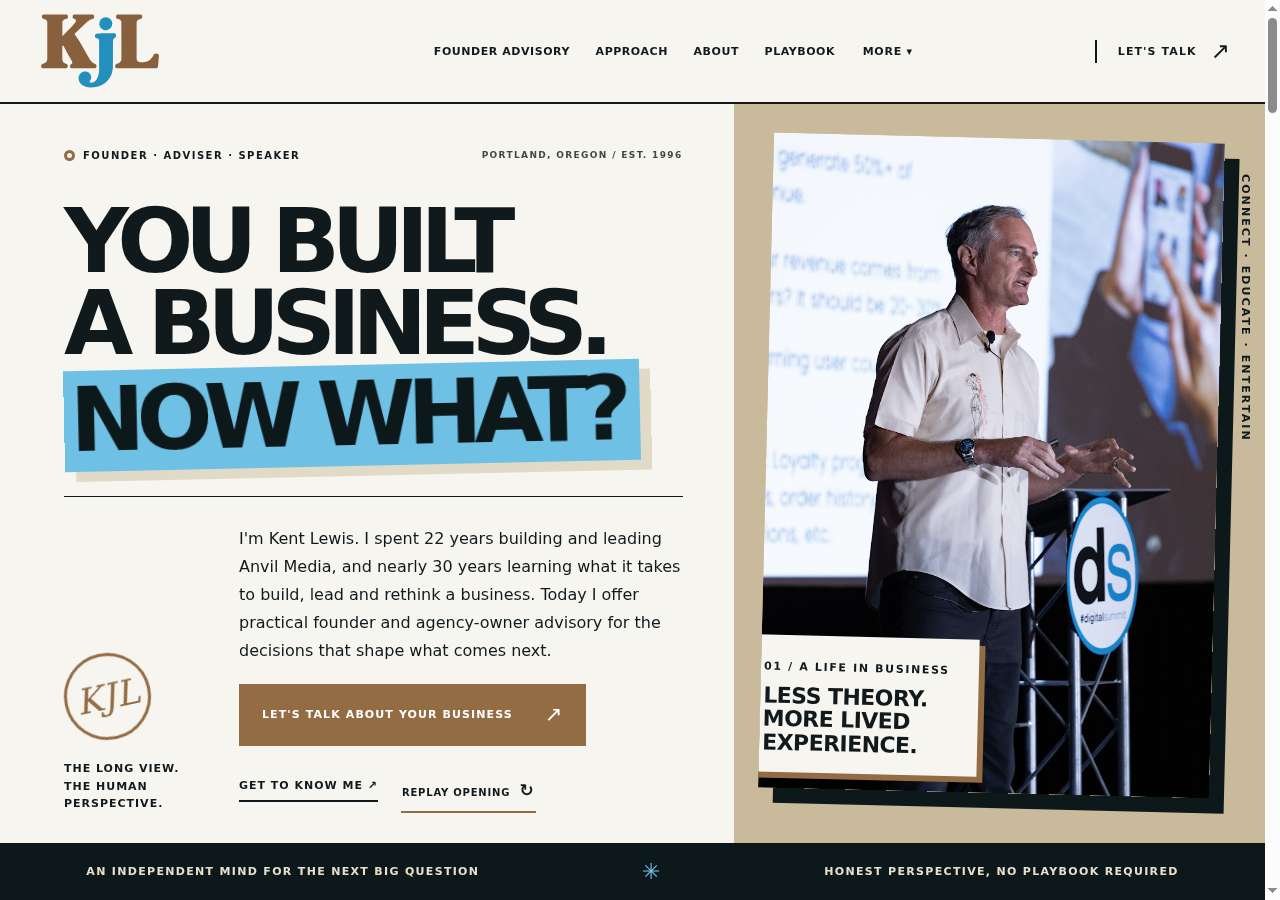
A consultant website often fails when the person behind it has a more interesting story than the template allows. Kent Lewis’s public personal-brand website brings a founder’s career into a clear editorial narrative, then separates advice for business owners, speaking for organisers and marketing-strategy conversations.
The test is practical: can a visitor recognise the relevant part of Kent’s experience and take a sensible next step without reading his entire biography? The three live examples above show those audience routes and his free Founder Decision Brief. This is an observable design case study, not a claim about his historic website fees or measured booking uplift.
The central design question: who is Kent now?
A career can contain many chapters. Kent Lewis founded Anvil Media, worked in marketing for decades, speaks publicly and advises business owners. An ordinary consultant homepage might compress all of that into a dense list of credentials and a stock-photo handshake.
The published Kent Lewis website takes a different route. Its opening asks, You built a business. Now what? The story then moves from his experience as an agency founder into the decisions people face when growth, leadership or the next career chapter become more complicated.
That is not a generic biography. It is a clearer answer to the prospective visitor’s question: why is this particular person worth a conversation?
We separated three audiences without losing one voice
The homepage presents three routes with distinct purposes: founder advisory, speaking and marketing strategy. A conference organiser needs a different next step from an agency founder considering delegation or an operator looking for a senior marketing perspective.
The editorial decision is simple but demanding: keep Kent’s voice consistent while allowing each service page to answer a different set of questions. The advisory pages explain format, boundaries and who the service suits. The speaking pathway talks to organisers; the strategy page speaks to leadership teams. No visitor has to decode a one-size-fits-all funnel.
The evidence is his experience and his writing
The site uses a career timeline, public talks, links to his published writing and lessons from founder life. It references the creation of pdxMindShare, his years leading Anvil and the later business transition, rather than treating longevity as a decorative badge.
Where a founder has genuine stories, thoughtful links are more credible than invented awards, made-up testimonials or vague claims about transforming companies. The visual language supports that: editorial typography, strong headlines, authentic event photography and generous space for his own words.
A free tool shows how a conversation might feel
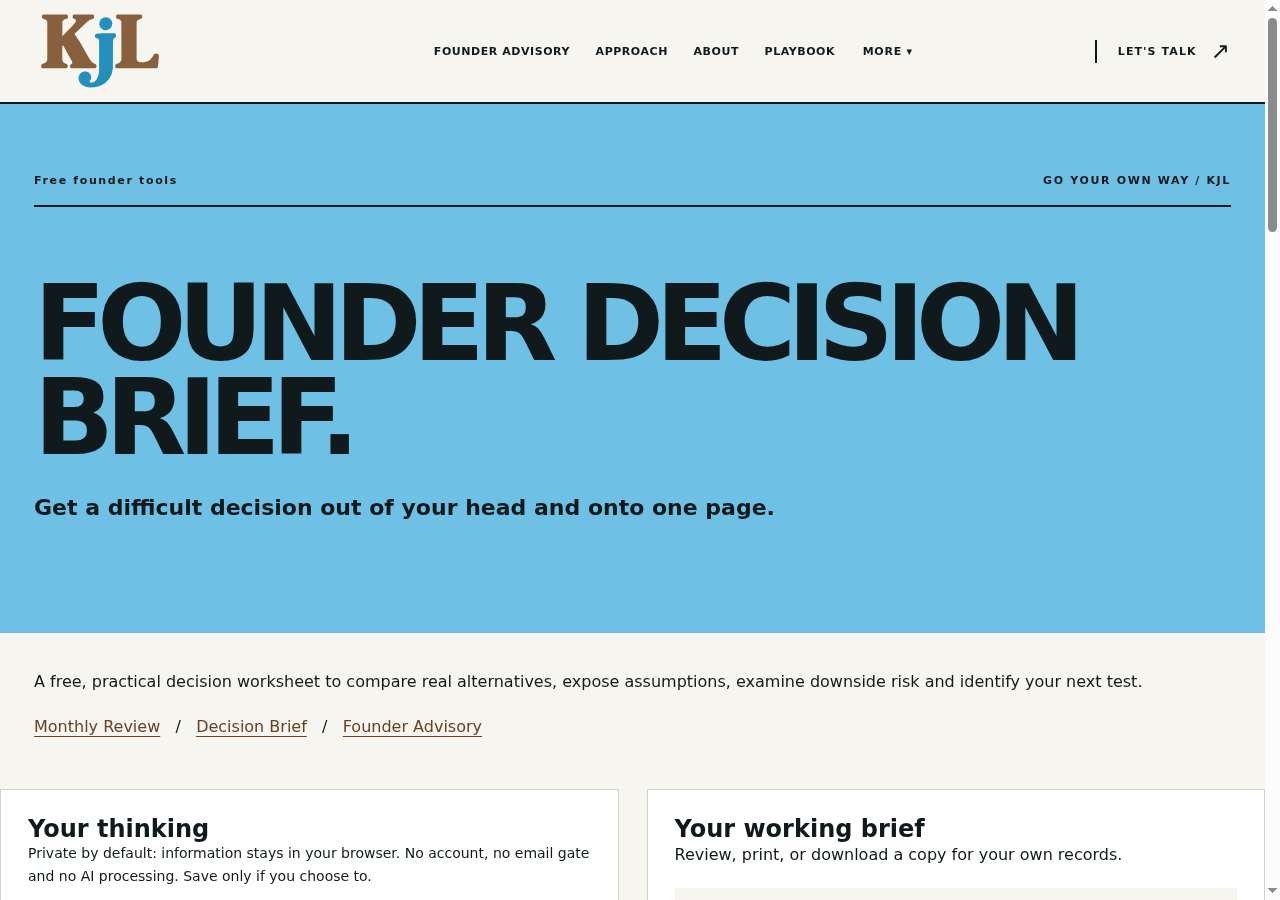
The Founder Decision Brief asks visitors to define an actual decision, alternatives, evidence, delay, downside, reversibility and next action. It can save locally, export a text or JSON record and print. Its interface says the work stays in the browser and that there is no email gate.
This is a small but meaningful product decision. Instead of simply claiming to offer clear thinking, the website gives visitors an example of the method before they commit to an advisory conversation.
What is observable on the finished website?
The live homepage, advisory page and decision tool demonstrate the hierarchy, storytelling and user journey. They do not verify that enquiry rates rose, that bookings increased or that the site earned any specific rankings. We have not reproduced supposed historical conversion figures or inferred the original commercial contract.
Nor do we confuse the £5,000 standard-site offer on Five Grand Websites with the actual historical cost of this particular project. The portfolio illustrates creative possibilities; scope and functionality are assessed separately.
A consultant website design decision matrix
| Visitor | They need to establish | Page or feature doing the work |
|---|---|---|
| Agency or business founder | Does this person understand the next difficult leadership decision? | Advisory explanation and the lived founder story |
| Conference organiser | Can this person communicate a valuable idea to an audience? | Separate speaking page and public experience |
| Marketing leader | What kind of senior strategic help is available? | Dedicated marketing advisory pathway |
| Curious reader | Is there useful thinking here before I enquire? | The no-email-gate Founder Decision Brief |
What makes this a personal brand website rather than a generic consultant template?
The narrative begins with Kent’s specific career transitions and questions, then connects them to individual services. A strong consulting website needs something that generic AI-produced positioning cannot supply: verifiable experiences, distinctive language, actual writing and clear professional boundaries.
Is it necessary to gate a consultant’s best resource?
Not always. The decision worksheet works without an email address and allows local saving or export. This example illustrates a trust-first conversion choice; it does not prove one funnel converts better than another.
What other consultants can learn
- Start with the client’s difficult question, not an inventory of your own job titles.
- Make each audience path visibly different, while preserving one human voice.
- Use genuine articles and lived experience as proof instead of empty social proof.
- Provide something genuinely helpful before requesting an email address.
For a broader commercial website approach see corporate and founder-led website design. This case study is specifically about the challenge of turning a complicated individual career into a clear personal-brand experience.
Verified 30 October 2026: live homepage, advisory page and Founder Decision Brief inspected. No contractual details, client approval statement, booking uplift or other unverified outcomes are asserted.