Educational resource website design: the brief
Project Selection is an independent UK military-preparation resource with a more useful starting question than “What training plan should everybody follow?” It asks the reader to identify their service, role and assessment stage before selecting source-backed guidance or general reasoning practice.
The public project combines route-specific information, independently written practice exercises and an optional private preparation board. Those features demonstrate a structured educational website with practical browser tools. They do not make Project Selection an official Armed Forces service, reproduce protected examinations or guarantee that somebody will pass selection.
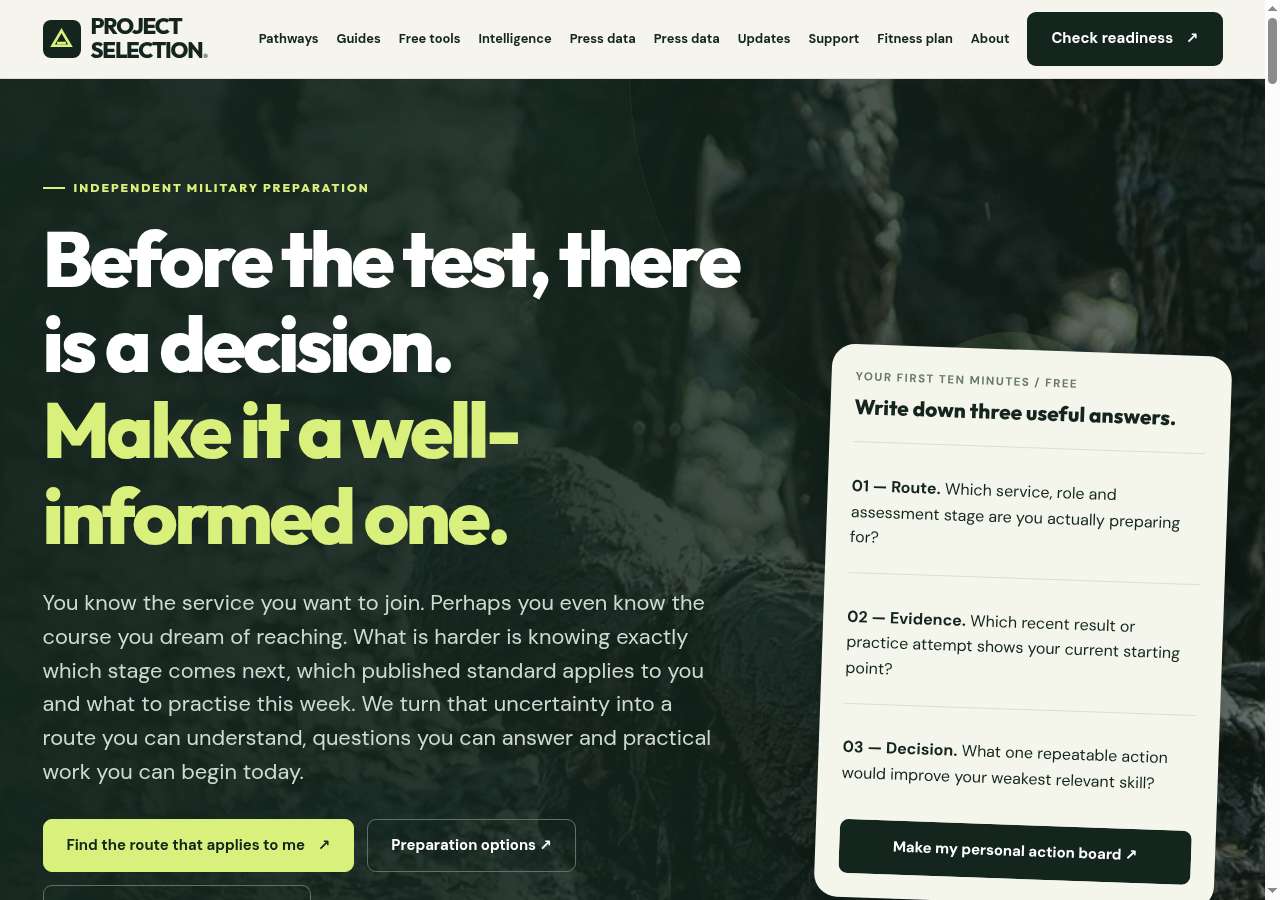
Start with the decision a reader actually faces
A prospective applicant does not necessarily need more motivational copy. They may need to learn which service, role and stage they are applying for, whether a published fitness threshold applies and what to practise this week. Generic preparation advice can be worse than useless if it compares the wrong test.
The live Project Selection site makes that problem its central design brief. Instead of a single heroic programme, it leads with a short action exercise: identify your route, cite a real starting point and decide the next useful step. The language is practical rather than militarised hype.
That is a transferable pattern for educational website design: don’t just provide information; explain which information fits the learner’s situation and what a sensible action looks like.
Eight routes are not eight cloned pages
The military preparation pathways distinguish the Army, Royal Navy, RAF, Royal Marines and other relevant role or selection tracks. Requirements change by branch, role, assessment stage and date. A Royal Navy general-entrant pre-joining assessment is not interchangeable with a specialist military assessment.
The content architecture therefore connects specific route pages to official references, original guidance and narrowly scoped practice. Readers can browse the standards tracker instead of trusting an anonymous, undated fitness claim.
This is information architecture as a safety feature. The site must show the source, stage and review date, while avoiding a fictitious overall readiness score or suggesting any single measure guarantees recruitment success.
A library of tools with genuine different jobs
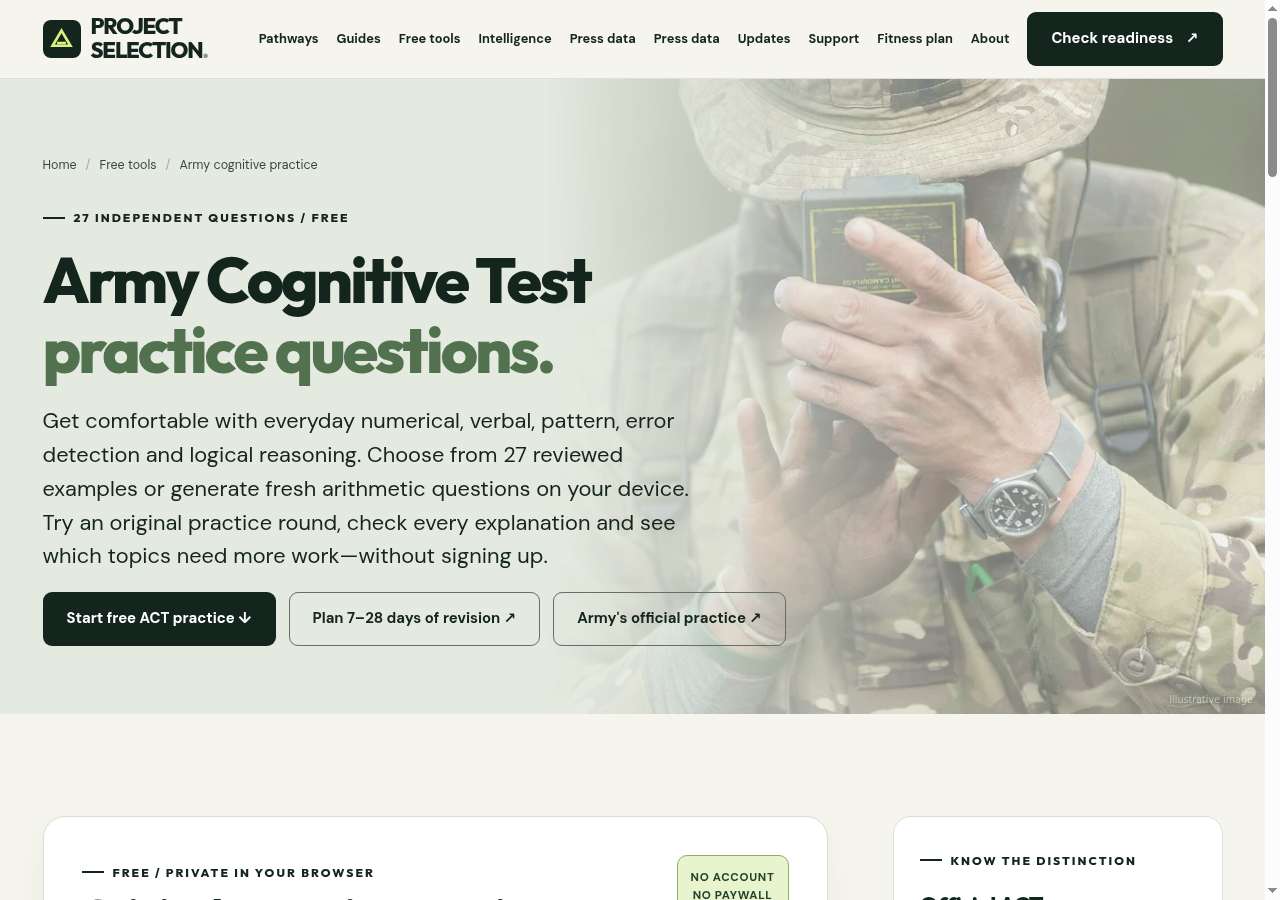
The free tools collection includes independent Army reasoning practice, RAF aptitude-style questions, running pace calculations, a bleep-test interpretation tool and individual planning exercises. Its Army Cognitive Test practice uses independently written questions with explanations, not copies of an official exam.
The preparation action board lets visitors organise source reading, general preparation and administrative follow-ups. It offers local-device storage and exports without asking for an account. This is a considered product choice: the visitor keeps control of their own information.
The combination of educational content and browser-based tools gives the website a reason to be used, not merely visited. But the interaction is carefully bounded. A pace calculator is arithmetic, not a training prescription; independent reasoning questions do not produce official assessment scores.
Why the founder story belongs in the design
The about page explains the founder’s first-hand interest in military preparation and endurance sport while carefully delimiting actual service and training history. The story answers why the information was assembled without claiming official authority. Authentic personal experience is useful context, not a substitute for current published standards.
The project demonstrates that a substantial learning platform needs several entry points: a route finder, a well-labelled research library, activity tools and a consistent way back to verified guidance.
Commercial relevance without a false comparison
Project Selection is a public independent information resource. It is not evidence that we delivered a commissioned website for a university, training provider or defence organisation, and no search-traffic, assessment-pass or conversion uplift is asserted.
A professional education business could borrow its route clarity, topic separation and small useful exercises. Accreditation, payment systems, user accounts, course delivery and safeguarding would require separate requirements and an explicitly costed build—not be presumed inside a standard £5,000 site.
What an effective educational website needs beyond articles
| Learner task | Project Selection feature | Instructional value |
|---|---|---|
| Identify the right requirement | Service and stage-specific pathways | Reduces the risk of practising for a different assessment. |
| Understand a weak area | Independently written reasoning exercises with explanations | Makes review more useful than a raw quiz percentage. |
| Translate reading into action | An optional private preparation board | Creates manageable follow-up tasks rather than an endless reading list. |
| Distinguish facts from assumptions | Official-source references and changing-standards tracker | Makes research auditable when policies or assessments change. |
Does a training website need a learning management system?
Not for every audience. This example shows how an information-rich static website and browser tools can support self-directed preparation without accounts, payments or a course platform. Accredited training, student records, certificates and protected assessments would require a different product scope.
How does original practice differ from official test content?
The exercises are independently written and explain general skills. They do not reproduce confidential recruitment materials or predict official Army or RAF results. That distinction is part of the design, not an afterthought.
Five design rules worth borrowing
- Help a learner select the applicable route before showing them an ocean of resources.
- Keep changing standards attached to official sources and review dates.
- Give each interactive exercise a meaningful learning purpose, not a gimmicky score.
- Provide printable or exportable next steps when they make the information actionable.
- Use a personal story to explain motivation, never to manufacture institutional endorsement.
Explore the other live website projects for different business models and design constraints. This is an education-and-tools example, not a duplicate training-provider sales page.
Verified 30 October 2026: homepage, pathways, tool directory, Army reasoning practice and action board inspected. No official endorsement, exam outcome or customer case-study contract is claimed.