Property sourcing website design: the project at a glance
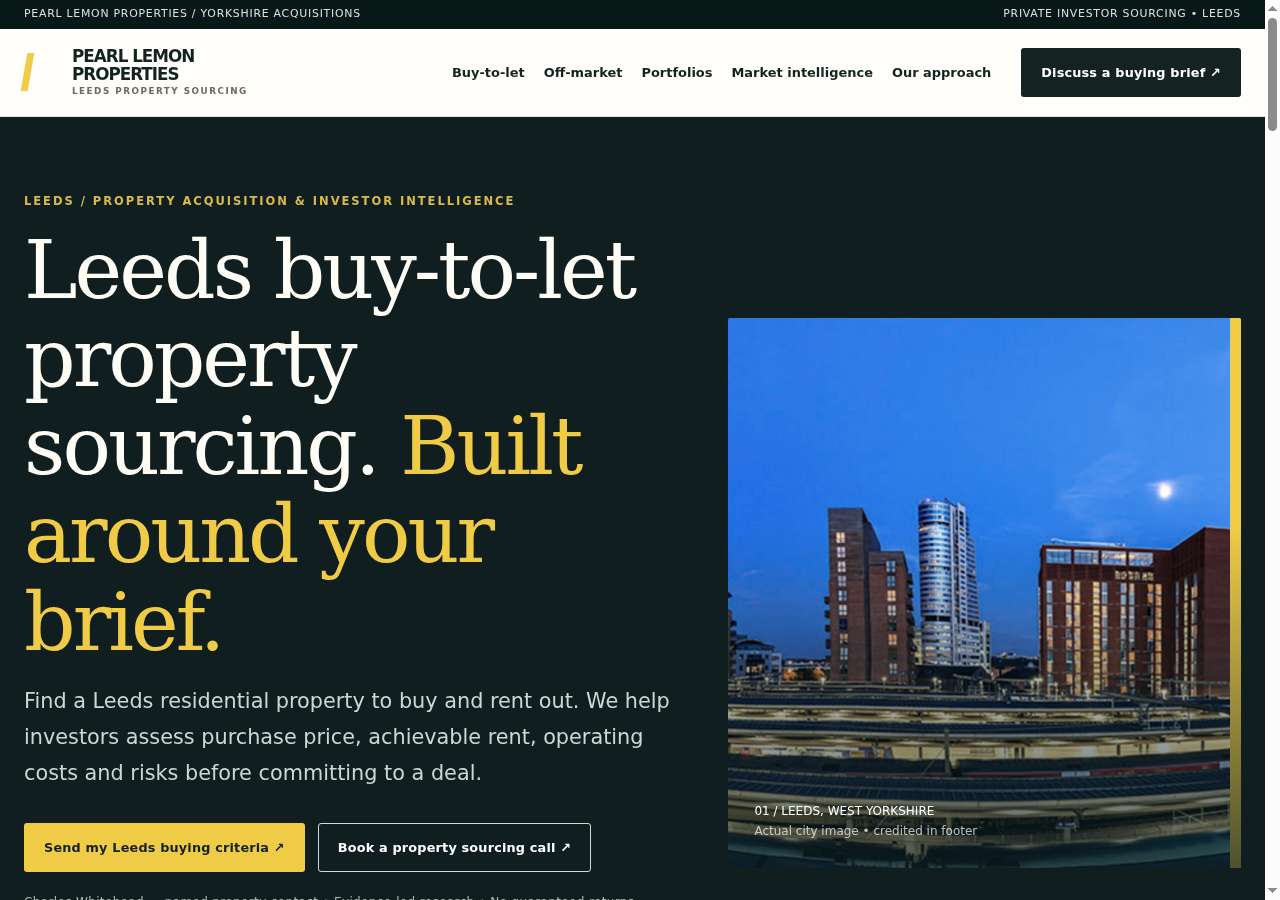
This property sourcing website design case study examines how a Leeds-focused investor journey can do more than display an appealing property photograph. Leeds Property Sourcing is part of Pearl Lemon Properties. Its pages introduce different investment strategies, local research and the cost assumptions that deserve attention before somebody submits a brief.
The live examples show a buy-to-let journey, an illustrative deal analyser and Leeds Article 4 research. Together they make the commercial decision more specific. They do not establish that the website generated more investors, completed any particular transactions or delivered the returns entered into the calculator.
The problem with glossy property websites
A property website can make every acquisition look straightforward: a dramatic skyline, a big yield number and an enquiry button. That would have been the wrong starting point for a serious sourcing business. Buyers need to understand finance, purchase costs, operating assumptions, licensing, location differences and the possibility that the right advice is to walk away.
The live Leeds Property Sourcing homepage now asks for the investor’s capital, preferred approach and timing. It tells readers that the initial brief is free but that any paid sourcing engagement, fees and responsibilities must be agreed separately. That is a conversion decision: fewer vague leads, more useful acquisition conversations.
Different investment strategies need different page journeys
The navigation separates buy-to-let sourcing, off-market property, HMOs, BRR projects, student property and portfolio acquisition. These are not six decorative cards for the same pitch. Each involves a different due-diligence question.
For an HMO, planning permission, Article 4 restrictions, licensing, fire safety and management obligations matter. For a BRR project, realistic works budgets, finance costs and refinancing assumptions may decide whether the model is viable. For buy-to-let, rental comparables, voids, service charges and repairs matter more than a single optimistic yield.
The supporting research connects visitors to Leeds property-market information, HMO Article 4 context and distinct neighbourhood pages. The design makes it easier to reach the relevant information instead of hiding everything below a generic property grid.
Building a useful investor tool, not a pretend forecast
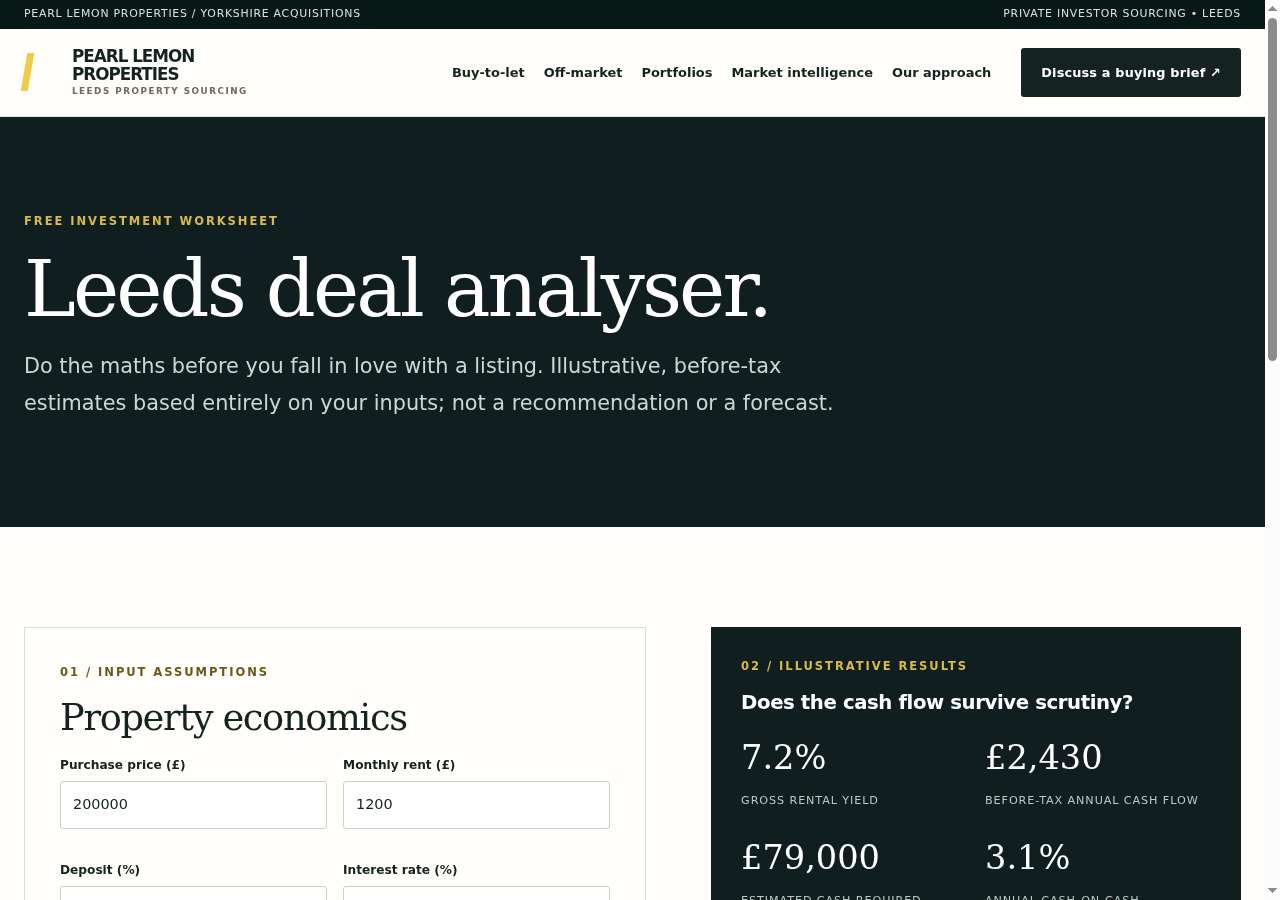
The Leeds deal analyser is a concrete differentiator. It accepts the visitor’s own purchase price, rent, deposit, interest rate, renovation budget, buying costs, fees and operating expenses. It then calculates illustrative yield, cash requirement and cash flow, including a downside rent assumption.
Crucially, sample inputs are identified as fictional. The calculator excludes certain tax and unexpected costs and cannot verify the property, lender rules or rental evidence. That restraint matters in a market where a beautiful calculator could otherwise lend false precision to a bad investment.
Trust comes from named accountability and specific geography
The site introduces Charles Whitehead as a director of Pearl Lemon Properties Limited and the named investor contact. It does not invent a Leeds office or completed local transaction history.
The local content also avoids treating Leeds as a single investment market. Headingley, Hyde Park, Armley, Beeston and city-centre apartments present different acquisition questions. We wanted the area architecture to support real decisions rather than mass-produce location pages with swapped place names.
How the site was built and made public
The project launched during October 2026 and was refined through a Cloudflare Workers implementation with production source preserved in the Pearl Lemon EMD Factory repository. The live pages expose public content and indexable metadata; initial technical launch checks included canonicals, a sitemap, navigation, the interactive tool and form behaviour.
A live, indexable site is not the same as a website already producing search enquiries. We have not included invented conversions, sourced deals, rental returns or traffic growth. Those would need verified operational and Search Console data.
Property website design decisions an investor can actually test
| Website decision | How Leeds Property Sourcing handles it | Transferable lesson |
|---|---|---|
| Separate investors by strategy | Distinct buy-to-let, HMO and BRR routes | Different transactions involve different questions and evidence. |
| Qualify before booking | An initial brief asks about capital, preferred strategy and timescale | Reduce vague enquiries by asking only decision-relevant questions. |
| Explain local due diligence | Area and Article 4 guidance are linked from the core journey | Local relevance should improve the user’s judgement, not just multiply location keywords. |
| Avoid misleading yield claims | The deal analyser exposes assumptions and downside scenarios | A calculator is not an audited investment return. |
Should a property sourcing website show live deals?
Only where the sourcing company can evidence the property, its status and the authority to market it. For a new service website, a documented methodology, named accountability and honest acquisition criteria are better than invented “sold” properties or fictional investor testimonials.
Does this example prove more investor enquiries?
No. The public site demonstrates page structure, research links and a practical tool. Without reliable analytics, CRM attribution and a comparable baseline, claiming improved leads or investor outcomes would be guesswork.
The transferable design lessons
- Begin the homepage with a useful buyer brief, not an unsubstantiated deal promise.
- Connect each property strategy to its real constraints, market evidence and next step.
- Let the calculator expose uncertainty, not disguise it as certainty.
- Name the person and legal business responsible for the conversation.
The property developer website design page covers a related but different business model. The Leeds project is a property-sourcing example—not a claim to have built an independent developer’s sales portal.
Verified 30 October 2026: live homepage, investor calculator and team profile inspected. No investor profit, guaranteed yield or third-party transaction testimonial is claimed.